Friday, December 6, 2013

December 6, Friday of Week One of Advent


 Once more Jesus spoke to them in parables, saying: 'The kingdom of heaven may be compared to a king who gave a wedding banquet for his son. He sent his slaves to call those who had been invited to the wedding banquet, but they would not come. Again he sent other slaves, saying, "Tell those who have been invited: Look, I have prepared my dinner, my oxen and my fat calves have been slaughtered, and everything is ready; come to the wedding banquet." (Matthew 22: 1-4)
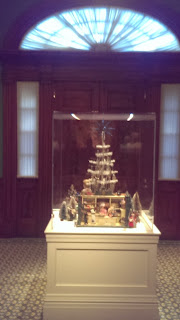
http://www.taftmuseum.org/This is the entry door for the Taft Museum in downtown Cincinnati. I bet there have been a couple of wedding banquets in the house over the last several decades. There's a huge dining room just off of this hallway. There's a large "living room" just behind the spot from where I took this photo. Plenty of gorgeous artwork and space for ritzy celebrations

You really should visit the Taft should you get the opportunity, especially in the weeks leading up to Christmas. There's a wonderful exhibit of 19th Century American and German handmade Christmas ornaments right at the entry into the older section of the house and museum. There are other Christmas decorations in many of the hallways such as the one in my photo.

I got to thinking though. What if you had never been to the museum and were standing outside on the other side of the doorway. What if you weren't able to see the beauty of the afternoon sunlight shining through the glass above the door, onto the carpet. What if you were outside and you had no visual comprehension of what was inside? What if you nothing about the banquet of beauty existing in the house? What if you had heard about the Taft Museum but had not yet seen it? Wouldn't this make your first visit there even more special!

Perhaps this sense of unknowing is more awe-inspiring if we think about it. What beauty would we behold if we truly lived into Advent.  Most of us, like the Taft Museum, have already decorated our homes for the holidays. Trees are up; lights are lit. Our family's traditional ornaments are artfully set out throughout the house. We're ready! Christmas is here.

It isn't though.... for those who are willing to wait on the other side of the hallway and door. God is preparing the banquet and Christ's incarnation is coming quickly, at least it is in traditional ways of understanding Christmastide. Dec. 25th is the beginning, not the ending of Christmas. We've just pushed up the celebration to begin sometime around the first of November. We can thank our culture for getting Santa and holiday cheer out in front of Saint Nicholas and a truer meaning of Divine love.

I mean I get it. I stopped at the Taft's gift shop and bought some stationary as a Christmas gift. I've got my wreath up on my front door and eyed getting some outdoor Christmas lights to place on the bushes outside of my front door. And yet, it's Advent. What if we had to wait for Jesus' return like Christians sitting by fireplaces did 200 years ago. What if we took some time to ponder what it's like to be invitees to God's Son's wedding banquet and actually show up with inquisitive hearts and minds.

Maybe this challenge is a "both/and" sort of situation. Perhaps we can experience Advent at some point in time each and every day leading up to Dec. 25th even as we experience the beauty surrounding us inside and outside of life's doorways and banquet halls. Maybe we should similarly recall that many people can't afford to visit upscale American museums or purchase holiday gifts and greeting cards either. Such realities come to mind when we don't place our secular Christmas expectations in front of John the Baptist's pleas to give your extra coat to someone who needs it.

I'm glad that our tour to the Taft didn't happen today. It's snowing very hard and the roads are slippery. Today, I have time to reflect upon the beauty I witnessed at the museum yesterday. I have time to reflect how hurried I felt leaving the museum in order to tend to other tasks that needed my attention. Today, I have more time to light a candle, sit in silence, and ponder what it will be like when I again encounter Christ's birth in my life in newborn ways, when the banquet will be especially ready.

Blessings Along The Way, Jim+
December 2 - Monday of Week One of Advent

Wednesday, December 4, 2013

December 4, Wednesday of Week One of Advent

December 3, Tuesday of Week One of Advent

http://www.missionstclare.com/english/December/morning/4m.html The Lord is not slow about his promise, as some think of slowness, but is patient with you, not wanting any to perish, but all to come to repentance. But the day of the Lord will come like a thief, and then the heavens will pass away with a loud noise, and the elements will be dissolved with fire, and the earth and everything that is done on it will be disclosed.  2 Peter 3: 9-10 
Frustration is a powerful emotion. I get frustrated when my expectations don't line up with what's actually going on at the moment. I want something to happen right now and it isn't taking place according to my desires. I want someone else to get a task done or get out of my way or whatever. In many cases I don't have any direct control over what's going on. I can't force the driver who is going to slow to push down his pedal. I can accelerate and go around him while I'm .... frustrated. Is that the proper and Divine solution. Maybe, maybe not.

The author of The Second Epistle (Book) of Peter seemingly is frustrated by a couple of big problems that he (they) can't seem to control.  First, there are some terrible false prophets out there preaching a sinful gospel. Second, he (they) seemingly are impatient with the manner in which early Christians are preparing for Christ's eagerly anticipated apocalyptic arrival. These challenges are seemingly quite frustrating. Early Christians expected Christ's imperial reign to happen during their lifetime.

http://www.huffingtonpost.com/judith-orloff-md/how-to-be-patient_b_1748430.htmlExpectations are tricky, especially when our hopes, anxieties, and desired outcomes don't match up with what's actually happening at the moment. The "blockages" causing our frustration may be something we are wrestling with internally or there may be external factors impacting our progress. That's a somewhat negative observation regarding frustration. A more optimistic viewpoint may be for us to focus on the underlying causes and opportunities for personal and spiritual growth that our frustration represents. What is causing the distress, anger, sadness, or bitterness we are experiencing and is there anything about who we are or what we believe prompting us to become frustrated? What might we do to amend our way of being or current approach to the frustrations we face each day.

Advent is a season of patience, repentance, and serenity in the moment. All of these virtues are wonderful if not disciplined anecdotes for frustration. What is within your sphere of influence to change now or in the future? What is outside of your control or something you should be (un)comfortable with for awhile as Christ enters into your life in new and unexpected ways? Dr. Judith Orloff (2012) defines "patience as an active state, a choice to hold tight until intuition says, "make your move." It (patience) means waiting your turn, knowing your turn will come. ... With patience, you're able to delay gratification, but doing so will make sense and feel right.  (para. 6).  May your Advent offer more opportunities for hopeful and patient deliberation and progress. I wish you peace in the midst of this season's frustrations. Providence is a good thing at the mall and elsewhere in daily life. 

O thou lover of (hu)mankind, send down into our hearts that peace which the world cannot give, and give us the peace in this world. O Ruler of Peace, keep us in love and charity, be our God, for we have none other beside thee; grant unto our souls the life of righteousness, that the death of sin may not prevail against us, or against any of thy people. Walter Farquhar Hook

Blessings Along The Way, Jim


Tuesday, December 3, 2013

December 3, Tuesday of Week One of Advent

December 2 - Monday of Week One of Advent

Heather Poast in a "easy seat."
I started taking yoga classes again about a month ago. I normally go to spinning class at Revolution Fitness on Monday mornings and Heather Poast started teaching that class. I liked Heather's teaching style & was hooked when she played Bruce Hornsby toward the end of the class.

Heather invited spinning class participants to come to her Tuesday morning hot yoga class. I was kinda intimidated because I hadn't practiced yoga in many years and I didn't want to look like a fool. On the other hand, I was looking for a less aerobic workout to add to my weekly exercise discipline. I was also looking for a means to regain some flexibility and re-connect my physicality with my spirituality. So, I started going to yoga on Tuesday mornings.

I absolutely love the class even though it's one of the most strenuous workouts I accomplish. I've got to know Heather just a little bit better and, like with the spinning, I appreciate how she makes me think about what I'm physically doing and what is my intention for each motion, each breath, each calorie that I'm burning.

Heather writes a blog named "Have a Namaste." Her posts let readers quickly know that yoga for her means alot more than just working out. Yoga informs how she lives her life. Yoga shapes how she eats, why she works at the jobs she work at, and why she truly "shines" the way she does. Most Westerners think that yoga is just another way to burn 750-1000 calories in an hour. True yogis and yoginis know that Yoga is a centuries old discipline that practitioners use to mutually and intentionally benefit their bodies, minds, and souls alike.

This should be the best intention of any religious practice, whether it be Hindu yoga or Christian Daily Prayer during Advent. We re-connect to The Divine and ourselves when we establish a disciplined and rhythmic practice of prayer and motion.  Franciscan priest, teacher, and mystic, Fr. Richard Rohr (2012) recently said  that most world religions seek to teach their believers that each person’s  ultimate purpose and reason for existence is to create union with God and all things. This is the simple goal of our existence. Rohr quite boldly says; "If your religion is not helping you to do that, then you’d better get a new religion."

Religion is something we practice and enjoy when we decide we desire to be healthier and in closer relationship with ourselves, God, and one another. It is in Advent, (December) for Christians when we can actively seek our Christ's arrival in any number of ways. Contemplative persons may light candles, breathe and watch. Students may gaze out past frosty windows and ponder what it means for God's life and Word to dwell with us once more. I don't know. For me, at least today, it's getting up early in the morning and driving across Cincinnati to sweat, stretch, and spend time with Heather and a few other people who inhale through their noses and exhale rather profusely out of their mouths while balancing on one foot. I don't get too embarrassed if I look unsteady or even clumsy. Heather doesn't seem to care. She keeps encouraging me. I receive her support as one way of God inviting me to continue showing up in my relationships with Christ, people I relate to, and myself. What will play and prayer look like for you as the days shorten and the opportunities for you to more deeply understand why you are here and what union with God looks like for you, now and in the days yet to unfold.

Blessings Along The Way, Jim+ 


Monday, December 2, 2013

December 2 - Monday of Week One of Advent

May grace and peace be yours in abundance in the knowledge of God and of Jesus our Lord.  His divine power has given us everything needed for life and godliness, through the knowledge of him who called us by his own glory and goodness. (2nd Peter 2: 1-3)

My cat Bono prefers to drink water from the water faucet. I've learned that it isn't unusual for cats to enjoy drinking running water as opposed to standing water. Running water is fresh, clean, and healthy. 

Bono always greets me at the kitchen faucet early in the morning, often in the afternoon, and almost all of the time in the evening. He occasionally still tries to get to me to turn the bathroom faucet on but that  feels kind of like a boundary violation to me. He's a good learner though. He knows that if he follows me to the kitchen sink that I'll turn on the water for him. He's likely to get his back scratched too.  It's a fun ritual, for both Bono and me.

Prayer during Advent is sort of like this ritual that my pet cat and I share. It requires us to show up and spend time in love with someone or something else, God. Fortunately God offers unconditional love. The divine faucet of love God offers is not dependent upon human emotional boundaries or the local water company's supply of H2O. It just "is." As the author of Peter's Second Epistle writes. God's divine power unceasingly pours out to us everything we need to life through Christ's glory and goodness.

Moreover, such prayer is grounded in one of Christianity's finest virtues: hope. Bono hopes that I'll turn the water on for him. He meows and especially purrs when he gets the water and his back scratched too. Is it any wonder that he shows up each day?  God gives us much more than 30 seconds of water and a couple of strokes with a brush with quite sharp bristles. In prayer, God gives us time and space to say or think about anything that we wish to offer. In turn, God assures us that whether or not we are thirsty for love, God is there to abide with us.

My prayer for you during the seasons of Advent and Christmas-Tide (December) is that you will rush to a silent faucet of fresh, clean, and healthy prayer at least once each day. I pray that you'll hope for God's presence to be nearby and available and that you'll make yourself available to God, ritually & intentionally. Lastly, if you have a pet, or special person you love; make sure they drink plenty of healthy water and give them an especially gracious shoulder rub that you've prepared  for them, and yourself.

Blessings Along The Way, Jim+ 

Monday, August 12, 2013

One guy's view on The Episcopal Church's Transformational Work.


I haven't written on my blog in awhile. Let's just say that I've been busy. One of the things that I've been working on is the Diocese of Southern Ohio's  Special Task Force on Restructuring. Bishop Breidenthal called for the formation of the task force at last year's convention and we've been working very hard for about a half a year now.  This work is not easy and readily defined. Transforming a person's individual life is difficult enough. Just pray with Jesus about that type of change. Changing a church or a diocese full of churches that are laden with numerous expectations, decades of liturgical, administrative, and pastoral practices - outdated or otherwise - is extraordinarily challenging. Such "change" requires wonderfully creative  people who commit to collaborating on a common purpose that is grounded in the truths and responsibilities of The Christian Gospel. The challenges and opportunities associated with with such resurrection are remarkably profound and borderline miraculous.

Needless to say, I get somewhat more than riled up when I read an article like the one that The Acts 8 Moment people posted on their Facebook page earlier today. Now, before I go further, I fully endorse Acts 8 in their mission to change "the conversation in The Episcopal Church from death to resurrection; while equipping The Episcopal Church to proclaim resurrection to the world." However, let's not presume that such resurrection happens through a continued process of harping about high administrative and human resource costs in an era of decreasing investments and revenue generation. Acts 8 uses Thom Schultz's work to suggest that we Episcopalians (and other organized Christian entities) are spending way, way too much money on administrative costs and not nearly enough on mission or direct ministries.


Let's agree that Pastor Schultz's data and hypothesis are legitimate. Let's also concurrently wonder about the implications for our churches as well as for other
denominational and non-denominational Christian faith communities. For example, raising up, caring for, and gathering in a building has been & still remains a paradigm most Christians are accustomed to for their worship and programs. Just ask the folks at Christ Episcopal Church Poughkeepsie about the costs associated with preserving their place of worship even as they transform their Christian mission for the 21st Century. What would they and the people around them have lost if their tower came crashing down one summer morning? Would everyone in that context had been better off if they closed their doors?  I'd further add that many Episcopal Church plants aim toward the construction of, and movement into a magnificent and expensive sacred ecclesiastical space. Episcopal Church of the Nativity in Scottsdale, AZ is a fine example of such a healthy, inspiring, and mission focused parish.

Like it or not, and I happen to like it on certain occasions, most Episcopalians are not familiar with, or attached to their altar and musical resources coming into and out of the church in wooden containers. Moreover, there are a host of other vastly more relevant matters that I, my colleagues on the diocese's task force as well as the Episcopal Church's Re-imagining Task Force,  the folks dwelling in The Acts 8 Moment, and those interested in living into Christianity in the present millennium must consider and vigorously and transform. First, could we please take serious time and thought to look at current realities in their entire contexts, especially from a holistic Episcopal Church point of view. The issues here are systemic not arbitrary, and our systems are presently performing as people want them to; otherwise they would be working in ways that would be more efficient, more radically creative, and more open to God's Spirit. We'd nimbly re-imagine and institutionally realign our organized Christian lives if the associated costs weren't so dire. We love creativity except when the gap between what's in place and what we desires seems too great. Indeed, we need to face up to the harsh realities of the cruciform death and loss happening in our own churches that will indeed invite us to accept new life.

For today's purposes, let's merely consider some of the basic yet monetarily grounded challenges that are in place. Let's admit for example that dioceses, the Pension Fund, The Church's Insurance Company, and other Episcopal Church structures presently impose many  "administrative costs" on parishes and churches. I get paid a particular salary and compensation at St. James Westwood because of salary and compensation guidelines that the Diocese of Southern Ohio has established. These guidelines exist in part because we have clergy coming out of seminary graduating with enormous debt. This is also the "job" that I trained for over a matter of many years. Maybe I should have remained in the private sector as a consultant. Maybe not. Regardless some, if not many dioceses do little to cover such expenses yet parishioners' expectations remain precisely the same across the denomination. They seek seminary-trained clergy. Maybe that needs to change. Maybe we can and should become a denomination where pastors serve without an extensive theological education. Ok, but, the denomination's current pension system punishes priests who do not work full-time or accept lower salary positions. Even if those processes were to change we would still have a denominational structure dictating, and righteously so, that churches pay for their staff's insurance and pension costs. 

Conversely, we do little if anything to educate and facilitate the manner in which clergy, congregations, and dioceses evangelize, perform their Gospel missions, and grow in increasingly secularized and suspicious societal settings. We haven't consciously or structurally transformed the church over the past two decades because we have focused on other priorities and avoided the real work of mergers, closures, and structural reforms that needed to happen during that time. Finally, we are presently not a denomination that is accustomed to having professionals with other responsibilities exercise leadership in parochial settings. These are the sorts of sacrifices we need to consciously and spiritually acknowledge that are in place as we either say yes to change or continue toward demise, institutionally and evangelically.

It's rather striking but not surprising we are where we are as Episcopalians. There's an increasing clamor for bi-vocational and part-time clergy. Duh! It's expensive to higher a person(s) who principally accomplishes the parish's administrative, pastoral, missional, and theological tasks. Scott Gunn has written some meaningful blog posts on this topic over at Seven Whole Days. It takes a whole church to accomplish The Church's Work.  However, the fact remains that many parishes are seeking clergy to fill billets who can't afford full-time clergy but inherently hope that the priest who comes and serves will accomplish full-time work.  We therefore need to, as Scott suggests, become more outward serving rather than inwardly concerned. We need to believe in Jesus the Christ's proclamation of the Good News, resiliently and boldly. These are concepts that we affirm but aren't particularly well accepted in many established parishes, especially declining parishes with aging congregations.

Tony Lorenzen offers some great advice for us as we consider and resolve cost and systematic issues in The Episcopal Church. Tony writes:   Our structures, our polity, our best practices, and our religious culture itself are based on the norms, communication technology, and social organization of a world that no longer exists.  ... Unless we become more flexible and more able to bounce back, we will not thrive. Indeed, let's not blindly presume such resiliency will happen just because we desire it to or that there will not be any sort of push back from established social or instituional systems comfortably in place. The creation of an Episcopal Church based upon contemporary norms, technology, and social organizational realities will be birthed through a lengthy process of engaging stakeholders, defining and accepting winners and losers. It may happen in communities that are smaller and consequently more adaptive. It may be that some larger institutional entities will actually have to collapse because of bankruptcy or financial insolvency. I don't know.  I do believe that persons exercising leadership must continually re-focus themselves and the people they endeavor to serve toward the acceptance of a shared purpose that brings us all into alignment with God's will for us. Then and only then might we be able to incarnate Jesus the Christ's compassion and Grace institutionally and meaningfully by proclaiming Anglicanism's mission in the world. Such transformation isn't only about reducing administrative costs. Such resurrection is much much more inspiring and earnest than technically changing budget priorities.

Blessings Along The Way.  Jim+

Friday, June 22, 2012

Budgeting - Getting into the messy details in a contemplative yet pragmatic way


It's been so long since I've been able to post something here. I wish that I took more time to keep my blog current. I'll work on that project during the summer when life should, at least hopefully, slow down a little bit.

I recall that I first started blogging when I was going through the ordination discernment process. I was very interested in The Episcopal Church's life, mission, and processes. Thus, it's not surprising that something that is presently going on in The Episcopal Church (re)captured my attention.  Episcopalian leaders will be gathering in Indianapolis for this year's (77th)  General Convention in about two weeks. Lay persons, priests, deacons, and bishops will work separately and with one another to work on and resolve hundreds of issues. The  Blue Book details all of the various committees, councils, and agencies working throughout the convention. Unquestionably, the most pressing and controversial issue facing the bishops and deputies is the work upon the denomination's 2013-2015 budget. The processes leading up to the adoption of this budget have been convoluted and unsettling. Many observers, including me, were shocked by the proposed cuts to Youth, Young Adult, and Campus Ministries. One of the church's brightest stars and a St. James parishioner made an excellent video explaining the impact a 90% budget reduction would make upon her, her family, and other Episcopalians. The Dean of Bexley Hall wrote a very penetrating and meanigful commentary about the entire process on his Crusty Old Dean blog.


Here's the deal, last night, I made some comments about this whole budget thing on The Rev. Scott Gunn's Facebook page.  I did so after learning that The Presiding Bishop had decided to submit her own budget. That felt odd to me because she's a member of the denomination's Executive Council and certainly should have had a major stake in their budgetary decisions and debate.  On some level, it feels like Presiding Bishop Schori was very unhappy with what happened with the Executive Council's activities so she is consequently using her organizational authority and leadership status to adopt a budget, that's probably better, on to the General Convention's docket. Top-down decision making and influence scares me, probably because of my military background. Then I read some more comments on Bishop Kirk Smith's blog this earlier today. I wrote some comments there that I won't repeat here.


Here's what I do want to say .... We continue to be in the midst of numerous reformations, within and outside of the Church. Reformations evolve through technical and adaptive changes. Technical changes are about managing and reallocating resources. Technical changes require managers, "leaders," or resource controllers to make rapid organizational or institutional decisions. They often if not always produce new results. That are rarely, if ever, transformational. Adaptive changes hold a greater possibility for truly reforming people, communities, and hopefully Christ's Church. They are messy, protracted, and usually more organic than disciplinary. Ronald Heifetz writes: "Leadership is about mobilizing people’s capacity to sift through and hold on to what’s essential from their past. (Leaders) sift through their organization’s past, or from their family, neighborhood, or community’s past, and hold on to what’s precious and essential from that past (in order) to)hold onto what’s essential. They carry that forward, and discard and let go of that which is no longer essential so that they can take advantage of the opportunities that are generated from these cross-boundary interactions and from contemporary life. 


I hope that The Episcopal Church's deputies and bishops will not get too bogged down in only figuring out technical solutions for our church's budgetary and canonical processes. I pray that they and we as a Church will venture out on to that longer and unforeseeable path like the early disciples and apostles did. I understand that we are by far more institutional and concretized than Sts. Peter and Paul. However, the General Convention, at least from my perspective is hardly post-modern and typically concerned with preserving the status quo. We Episcopalians speak publicly about desiring to become more organic but most of our responses and actions are truly more technical than adaptive. Those persons exercising leadership need to boldly, faithfully, act in an integrated manner. There is an important maxim that I am in the process of learning from Hugh O'Doherty through the Clergy Leadership Project.   It is: "People only take responsibility for those things and actions that they help to create." I am striving to live into such leadership behaviors as a priest, pastor and person. I pray that the Holy Spirit will be present in Indianapolis, especially as Episcopalians discuss the budget and other life-changing and hopefully transformational challenges/opportunities that will be present there.  


Blessings Along The Way, Jim+

Thursday, May 24, 2012

Approaching-the-Day-of-Pentecost


You can read more of my thoughts about Pentecost in our parish's newsletter, St. James' Weekly Epistle. Let me know what you think or how Pentecost will transform you this year.

Blessings Along The Way, Jim+