Showing posts with label Episcopal Church. Show all posts

Monday, September 26, 2011

Welcoming and Working Parishes

I'm glad to see that my "stand out" friend and blogger The Rev. Scott Gunn is back to blogging again. I've missed his work while coincidentally understanding how difficult it is to keep writing ingenuous posts while beginning a new vocational undertaking. Scott+ has been very busy, I think, getting settled at Forward Movement. Godspeed and blessings for him and his staff as they strive to transform that organization into a vibrant evangelistic 21st Century Episcopalian publisher. Their transformational mission is to "reinvigorate the life of the church and to rehabilitate its general, diocesan, and parochial work.” Scott+ possesses a much grander mission to accomplish in comparison to mine as the new Rector of St. James Episcopal Church - Westwood. He's nonetheless found the time to crank up his worthwhile blog: Seven Whole Days. He's consequently inspired me to get back to continuing my virtual quandary of the Christian life here.

I've missed my writing. I find blogging to be a cathartic and contemplative spiritual practice even as I ponder what it means to be a faithful Christian disciple, leader, preacher, and teacher. I infer that Scott+ and I both are interested in seeing that The Episcopal Church and its parishes that we serve and love will not continue to decline in membership and missionary influence in local neighborhoods and across the broader Anglican Communion. C. Kirk Hadaway suggests that there are some factors such as where our parishes are located and the demographic makeup of the neighborhoods where our churches reside that we have little control over as we accomplish the work that God has given us to do in our ministries and programmatic vineyards. (Image by Matt Glover) Nonetheless, as Scott+ points out in his most recent post; there's plenty that we do have a great deal of control and influence over as we "welcome" new and reluctant members to join us in worshipping God and proclaiming Christ's Gospel in innovative and life-giving ways. We can ensure that we indeed welcome guests when they come to visit our churches to worship with us. We can (re)learn how to practice hospitality and the care for newcomers in our midst. Scott+ wrote: "I’m not breaking new ground when I say that most congregations simply aren’t welcoming. Sure, the current members feel welcome, but that’s because they’re already in the club. If you show up as a new face, there’s often a distinct lack of warmth. When I visit congregations, I’m usually not wearing a clerical collar, so I get the same welcome that they’d give any guest. It’s usually not much of a welcome at all." Those are disquieting words but they are indicative of my previous visits to many Episcopal Churches around the country. These communities aren't unusual - it's human nature to form communities that are comfortable and often exclusionary. The truth is though, our parishes and our work as stewards apostolic Anglican stewards will indeed die if we don't embrace a different way of "being church."

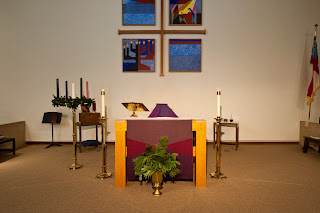
I'll be honest. I've been so busy focusing on making sure that my microphone works and the acolytes are vested that I haven't placed as much emphasis on our hospitality as I should. I did do a couple of things yesterday though. I went out to the curb before our 8:00 am services and waved to drivers-by - just to say hello. I almost immediately noticed that someone had written graffiti on our church sign. That event led me to consider whether or not signs on the lawns outside of our churches are value-added. That thought led me to more ponder an even deeper question: What are the living "signs" of a "successful parish. I didn't have to look very far. They are symbolically there on the side of our buildings and inside our chancel. The cross, the altar, and the presence of Christ in communion with us and one another are the visible and "living" signs of who Jesus Christ is calling us to be.
I agree with everything that Scott is writing about in his blog and I think that there is even more for us to consider. We aren't only welcoming people to come and be with us so that our churches don't close and our dioceses decline. We're proclaiming a message that's counter-cultural to the people around us and to ourselves. One of our primary goals is to obediently and humbly follow Christ to the Cross and beyond. We don't live for our own well-being. We live for the benefit and Grace of others and the world that we live in.

Paul in the Second Chapter of Philippians writes: "Do nothing from selfish ambition or conceit, but in humility regard others as better than yourselves. Let each of you look not to your own interests, but to the interests of others. Let the same mind be in you that was in Christ Jesus," (Philippians 2: 3-5). The Cross is a symbol for our death-defying acts of compassion that we share with our guests. The altar is the symbolic and "real world" place where Christians offer their time, talents, and treasures to their faith community and The Lord they follow and serve. The fact that there are few East-facing and standing altars in Episcopal Churches expresses the fact that our altars are not only about some sort of mysterious consecratory, ritualistic acts. We now welcome younger and older people alike to share in the sacramental and liturgical work that we are doing with one another. Lastly, communion unites us with Christ and one another. Jesus the Christ is present with us every time we meet one another at the altar rail. We are fed there so that we can feed others.

Each and all of these living symbols are the basis for our hospitality and, still more, the reasons for proclaiming the faith that we share with our guests in our parishes as well as in all of the other hospitable work that Jesus Christ is calling us to do.

I will be spending more time thinking, writing (blogging), and preaching about Paul's Letter to the Philippians over the course of the next couple of weeks. I'll get to that right after tending to the graffiti. Truthfully, I'm thinking that the manner in which Paul shared Christ's Gospel with the people of Philippi is still true and "value-added" for us. The Church at Philippi began as a small prayer meeting house and grew over time until it became a large cathedral. Paul's ministry in that place to Gentiles from Italy and Greece thrived over time. It also thrived because there were active gold mines there too. Nonetheless Paul implored the Philippians (and us) to imitate Christ by pouring ourselves and our churches out for the people nearby. That's an alternative yet apostolic message that I believe will resonate with people who are searching for God as well as welcoming opportunities to make a difference in the neighborhoods, suburbs, downtown locations, and rural settings where our Episcopal parishes are established and yet to come into being.

Blessings Along The Way, Jim+


Sunday, June 19, 2011

Trinity Sunday

I’d like to break down this whole 400 years of Christian Trinitarianism theology into more accessible terms. How is God? Where and When can we actually experience and live into the truth of the Holy Trinity’s presence? What is the Essence of God?
First - God is Creative – God’s Being is dynamically unfolding in the universe as well as our lives. The Creator God is a Divinity that is beyond our understanding even while very much located within our own nature – God is the Divine Spark who, from a theological perspective has been present since the beginning, even before the beginning of time. and yet – God is as close as the very next breath that you do not command on your own.
The most profound act of our God’s creativity in human history
was to incarnate and become one of us as Jesus of Nazareth and Jesus the Christ. God’s desire to be in relationship with us is so divinely devotional that God entered into this world to live and die as one of us. The almighty manifested this Divine affection through acts of compassion, justice, and sacrifice.

The Son of God chose human death and suffering as a means to redeem humanity from evil and death. Christ’s Baptism, communion, and Easter Victory over sin and death are the grace-filled means that God willingly expresses in order to connect with us.

The World urges us to look out for #1; to avoid confronting the realities of impoverished people.
Christ's resurrection reconciles us to God and to one another. Our secular lives provoke us to protect what is ours – to use violence when necessary to get our way. Christ’s death on the Cross and appearance to Mary Magdalene and the disciples on Easter teaches us that sacrificial love and Grace are how we will bring God's Reign and Peace into our world.>

Moreover, God is Relational, not oppressive. Jesus teaches us the truth of being truly Christian by teaching us the Good Samaritan, acting like the Woman who found the Lost Pearl, and understanding the profoundly inclusive nature of the Grand Banquet.

Lastly God is Spiritual – That principle sounds silly but some Christians believe that the Church is a social service agency or a ritualistic means for gathering with people who think, act, and believe like we do. Our Triune God beckons us to prayer. The Spirit’s Wind and Voice move over and around us to call us into deeper understanding of God, Ourselves, Our World and all of those needs.

A Christian cannot deeply discern the mystery of the Holy Trinity unless she or he is willing to intentionally live a life of Prayer. The Trinity’s Hospitality is understood not only through tithing but also through the gifts of the Spirit – Teaching, listening to God, preaching, singing, Painting, Laughing – all of the emotive and expressive aspects of who we are – at their best are the Spirit’s means of saying to us – God is Creative, God is Relational, and God is Yearning to abide with you so that you will become better at abiding with God and One another.

If little or any of this is incomprehensible – remember this. God is Love and Love is a Relationship. God creates because the endless joy and peace and shared life at the heart of God knows no other way to live. Jesus invites us into that relationship. Jesus is the one at the center of the Triune relationship who is at one with God and makes it possible for us to be one with them. This God who desires our relationship is constantly on a Holy and Spiritual pilgrimage to find companions to assist in perfecting the ongoing creation of the world. This Spirit, as she did at Pentecost is brooding over people as a mother hen broods over her chickens – God's Holy Sirit is fiery and yet she speaks softly to each and every one of us in particularly meaningful ways. Care to join the conversation at God's communion table>?

Blessings Along The Way

Sunday, May 22, 2011

Easter 5A

We can laugh and make fun about the fact that the rapture “didn’t happen” – it seems kinda ridiculous to some of us but the fact is that some people believe that Jesus left them behind yesterday. They feel outcast. Some people have sold their homes. Some people are opening empty refrigerators this morning.

One man, according to the Washington Post, packed up his minivan and drove his family 3,000 miles from Maryland to California. Keith Bauer told a reporter: “I had some skepticism but I was trying to push the skepticism away because I believe in God."

The problem with such apocalyptic thinking is that it is grounded in a “Gnostic” theology that orthodox and pluralist Christians reject, albeit for different reasons. “Gnostics” such as Harold Camping believe that they have a special knowledge permitting them and others to escape this earth while sharing a more holy relationship with God. Early Christian Gnostics sought out one another to share secret symbols and information in an effort to determine how to escape a world they viewed as ghastly wicked and corrupt. Many of them believed Jesus Christ to be the divine means for escaping their gruesome bodies and this imperfect plain of existence.

It’s difficult for me to read this morning’s text and come away with a sense of Jesus abandoning his followers. This morning’s Gospel doesn’t readily read as if Christ has got a special book and space for a select group of people. In my father’s house – there are many mansions and I go to prepare a place for you. That space is for the doubting Thomas’ of the world. That mansion is for the denying Peters of the world. That relationship with God is for anyone who seeks God and desires a deeper relationship with God. We place our faith in the conviction that The Way that we create, such belief is through an enduring relationship with Jesus the Christ who lived and lives in this world. We hope that such faith is sustained through Jesus Christ’s presence on this planet, his sacrificing death and the Cross and the victory of his death through his Resurrection from the tomb on Easter Sunday morning. We believe that he will return one day without knowing when that day is – and meanwhile that he is sustaining us to go out into the world rejoicing in the power of the Holy Spirit to proclaim through Word and Deed that Christ is not dead nor are we leaving to meet him in the air. We are Jesus Christ’s Living Stones. We may be babies in the faith but God is calling us to proclaim Christ’s Grace through our words and our deeds. You can hear more here:

Monday, May 16, 2011

More on Abundance

We all desire (perhaps are in want of) being "understood." Yesterday, I preached from John 10: 1-10 about the profundity and depth of knowing and believing in Jesus' love. What was most amazing about that sermon and Eucharist that I spent with the amazing people of St. George's was that it was just a slice of holiness that was placed in between a number of other sacramentally sacred moments over the course of 50 hours or thereabouts.

The sacred space and time began with the arrival of my companion - a man that has loved me and been a blessing to me for more than six years now. His wisdom and encouragement were instrumental in making the remainder of the weekend so special for me and for others. We dined at Trinity and The Pope, and celebrated the end of the academic year for him. We got massages later on in the weekend as a means for reducing some stress from the tensions that ministry and teaching often bring. Here's a "shout out" for Maria Friedman. It's amazing what a skilled massage therapist can do when she or he knows who you are and how your body works.

I then had the great joy of presiding @ John and Cate's wedding. They are a terrific couple. I have a special place in my heart for them and Cate's parents. Her dad is my friend and has been a helpful adviser as well. John and Cate's vows have a great chance of bearing delicious fruit because of their obvious love and care for one another, Christ's love for them, and the support of their families and friends.

Familial and friendly compassion: such love was extremely manifest and present at yesterday's confirmation service at St. James Episcopal Church in Long Branch. I was pleased to present 14 of our parish's young people and 1 mature adult for confirmation and reception as Episcopalians. I was blessed to places hands on each of their shoulders as +George confirmed them. He asked them if they were "signing up for Jesus." The music was beautiful; the setting, sacred. "What a perfect day!!" as once parent said.

What followed though was expecially tender and touching as +George and I went to the home of another confirmand. We went to the home because this young man's father is dying. We were greated by the young man and his mother. We confirmed him in the presence of his uncle who is his mentor, his father and mother, and more than 25 other family members and friends. We broke bread and drank wine. We laid hands on, and prayed for a loving parent who is leaving this life too soon. There was laughter, there were tears. There were words, there was silence. There was space and grace to be understood. John writes: "From the fullness of Christ's grace we have all received one blessing after another." (John 1:16) Such grace was constantly present all weekend long. My MasterCard was helpful for some of it. Jesus the Christ's love embraced every single moment of the weekend. I'm thankful and humbled to be held and cared for by such a God as well as by Christ's people who surround me and love God and me.

Thich Nhat Hahn writes: "People usually consider walking on water or in thin air a miracle. But I think the real miracle is not to walk either on water or in thin air, but to walk on earth. Every day we are engaged in a miracle which we don't even recognize: a blue sky, white clouds, green leaves, the black, curious eyes of a child - our own two eyes. All is a miracle." He is correct but there's more to it than that when Christ enters into the suffering, celebration, and sharing of understanding of our lives to one another and to God. There's a deeper and more intense sense of mortal life's limitations but everlasting hope in Christ's presence as the Good Shepherd and the door that Christians come and go through in this life and the lives to come. It's a blessing to believe that Jesus the Christ knows each of us and gives us the freedom to be more vulnerable and thoughtful towards one another. It's a unbelievable gift to be a priest and to participate in and observe God's love in times such as these I lived into over the past few days. Such abundance is undeserved but awesome to behold.

Blessings Along The Way,


Wednesday, May 11, 2011

Hanging Around with Jesus


He left the meeting place and went to Simon's house. Simon's mother-in-law was running a high fever and they asked him to do something for her. He stood over her, told the fever to leave—and it left. Before they knew it, she was up getting dinner for them.

When the sun went down, everyone who had anyone sick with some ailment or other brought them to him. One by one he placed his hands on them and healed them. Demons left in droves, screaming, "Son of God! You're the Son of God!" But he shut them up, refusing to let them speak because they knew too much, knew him to be the Messiah.

He left the next day for open country. But the crowds went looking and, when they found him, clung to him so he couldn't go on. He told them, "Don't you realize that there are yet other villages where I have to tell the Message of God's kingdom, that this is the work God sent me to do?" Meanwhile he continued preaching in the meeting places of Galilee.(Luke 4: 38-44 - The Message)

There's something very interesting and incarnational going on in Luke's gospel. People want Jesus to hang around with them for awhile. It's true in Peter's Mother-In-Law's house. It's true on the shores of Lake Gennesaret in Chapter 5. It was true back there in the synagogue in Nazareth until Jesus told his hometown neighbors that they weren't the focus of his life anymore. Then they tried to throw him off of a cliff. 'Can't please everybody, especially if they knew you as a kid. Cleopas and his traveling companion on the other hand. They got to travel along and break bread with the Risen Christ and personally encounter God's realm in a special way.

Jesus' healing truly touched people. Jesus' prophetic teachings truly inspired people. Jesus Christ's life, death, and resurrection truly transformed people. People desired to remain in contact with him.

So, here's the question: Now that Jesus is gone and The Church is here -=- Why aren't people as excited? I mean I get the whole miracle thing - I imagine most mainline Christian Churches would have hundreds of more members if the pastors could pull off returning sight to a blind person and/or energize in and out of the nave every now Linkand then. I don't think that's the reason though. I'm confident that Jesus attracted followers despite his divine abilities. The evangelists such as St. Paul rarely if ever mention the fact that Jesus was a miracle-worker. They did declare that Jesus the Christ's presence radically changed lives.

That's the Gospel that doesn't seem to have as much traction as it did on the Road to Emmaus and in Peter's Mother-In-Law's house. We are struggling with encountering the Risen Christ, perhaps God generally. Emergent Church leader Tony Jones was recently wrestling with this type of question. He was defending his dissertation at Princeton Theological Seminary when one of his examiners asked him: How is God revealed to human beings? Jones seemingly struggled with a response during the defense but subsequently, along with the help of Peter Rollins came up with this brilliant answer: “God is an event,” said Pete, “And liturgical practices are the ways that human beings organize their experience of the event they call ‘God.’”

Episcopalians should have the corner on God if liturgical practices and the Incarnation are the means by which human beings come into close contact with The Divine. I conceptually love the idea of God being more of a verb than a noun. However Jesus the Christ was someone who impacted people, personally, tactilely. We as The Church need to be capable of doing that through Christ's presence in the sacraments and in our ministries. We need to be reaching out to people and joining up with Christ out there in the real world. We similarly need to be hanging out more closely, and inviting Jesus more authentically and relevantly into our liturgies and Bible studies. We may not be able to raise people from the dead but we can surely share the story of Jesus who has risen from the grave to re-create our lives and redeem the world. We can break bread with one another in such ways that we invite Jesus right into our very midst, our very hearts. We can hope that healing will take place even as we consume the bread and wine that Jesus shared with his disciples in the Upper Room and Emmaus. We can believe, give consent to the truth that hanging with Jesus is still as possible today even as it was 2,000 years ago, even if we can't see him.

Monday, May 9, 2011

Being Yourself as a Christian and as a church

When he came to Nazareth, where he had been brought up, he went to the synagogue on the sabbath day, as was his custom. He stood up to read, and the scroll of the prophet Isaiah was given to him. He unrolled the scroll and found the place where it was written: ‘The Spirit of the Lord is upon me,
because he has anointed me
to bring good news to the poor. He has sent me to proclaim release to the captives
and recovery of sight to the blind,
to let the oppressed go free, to proclaim the year of the Lord’s favour.’ And he rolled up the scroll, gave it back to the attendant, and sat down. The eyes of all in the synagogue were fixed on him. Then he began to say to them, ‘Today this scripture has been fulfilled in your hearing.’
(Luke 4: 15-21)

I really appreciate this passage of Scripture from Luke. Its values reside at the core of Jesus' life and ministries. The Gospel virtues of compassion, good news through Jesus' life, death, and resurrection, and our thankful participation in co-Creating Christ's peaceful reign are central to the Church's work, here and now. All of that is true for me but what I find most important to me this morning is this thought: Jesus of Nazareth was a truly authentic, independent person, and motivated human being.

It took Jesus a tremendous amount of courage to walk into his hometown and tell his family and friends that God possessed a bigger plan for him than only taking care of them and their needs. It took Jesus tremendous perseverance to intentionally live into each day solely with the end in mind of tending to other people's needs, especially sick, economically poor, and lonely folks. It took Jesus God-given strength to lead his followers into a deeper understanding of how truly good and loving God is. Jesus had to trust upon Divine self-sufficiency to push back against oppressive systems and greedy people. Jesus' transcendent authority and/or uncanny Grace was definitely the means by which he escaped an angry mob so that he could continue to authentically live into God's plan for his life, and ours. Jesus was so blessedly independent that he went to the Cross and rose from the tomb to demonstrate and proclaim that eternal life is not to be found in adopting this world's values or someone else's perspective. Truth and everlasting life is found by believing in Christ's Way of Life and God's understanding of Creation, not the fame and fortune that the world often offers. Jesus was so "holy" (sic) independent, yet so mutually interdependent with us that his Word continues to invite us into living similar and life giving lives with and through him.

I subscribe to the "How to of the Day" website on my IGoogle page. Today's teaching was pretty cool, 10 ideas on "How to Be Yourself." There were some really good ideas: 1.) Find Yourself and Define Yourself on your Own Terms. 2.) Avoid Fixating on The Past and Not Letting Yourself Grow. 3.) Stop Caring about How Other People Perceive You. 4.) Be Honest and Open. 5.) Relax. 6.) Treat Yourself as you Would Treat Your Own Friend (sorta the opposite of the Golden Rule). 7.) Develop and Express Your Own Individuality. 8.) Stop Comparing Yourself to Others. 9.) Follow Your Own Style. 10.) Accept that some Days You are the Pigeon and Some Days you are the Statue.

Consider how Jesus is or isn't present in these suggestions. He defined his life, teachings, and the Law in his own fashion. He didn't back down to the religious or civic authorities of his time. He was keenly honest especially with those who were his companions. He didn't accept the status quo of his time, or ours. There's much for us as Christians and Christ's Church to adopt in Luke 4 and WikiHow's suggestions. There are plenty of people and parishes who struggle to escape from their past shadows. Many of us as well as the churches we belong to yearn to be like somebody else or the successful congregation down the street. We're so busy seeking to become someone or something that we're not instead of living more authentically into who we are. This is an especially difficult predicament for denominational communities who have a set of doctrines and disciplines they must adhere to in order to belong to their religious affiliations. (I think that notion is called orthodoxy in much of Christian history). I would counter by suggesting that uniformity and unity are not synonymous and the Church has rarely if ever been monolithic. Nonetheless, the Gospel's core values and commandments should shape our faith and day-to day living rather than our own selfish desires to live as we chose rather than how Jesus the Christ did, and does.

Here's my prayer that God will bless you with some opportunities to speak the Truth as Jesus did to his fellow Nazarenes. Here's my hope that you will embrace an opportunity to find the meaning of your life today with a Jesus-inspired moment. Here's a wish for our Church to become just a little less tense and a little more creatively enlightened today & in the days to come.

Blessings Along The Way...

Thursday, March 31, 2011

Lightening it up for a change


Krister Stendahl was quite a man. He was at one time the Bishop of Stockholm. Earlier on in his life, he taught New Testament Studies at Harvard Divinity School. He was the school's dean from 1968-1979, quite a tumultuous yet exciting time in American politics and theology. The Divinity School's obituary wrote about him in this way:

"During his tenure as Dean, from 1968 to 1979, Stendahl presided over the continuing transformation of the School, whose student body, faculty, and curriculum grew and became much more diverse, especially in regard to women and African Americans and to studies in religion specifically linked to those groups. Throughout this time—one of the most tumultuous political eras of American history, on college campuses and elsewhere—Stendahl successfully guided HDS with an astute, sometimes blunt decisiveness that was tempered by his wry humor and his enormous gift for listening, which were part of a complete, and consistent, pastorly presence." (Harvard Divinity School, nd, para. 7)

There's an urban legend that Stendahl was preaching at an important gathering of the divinity's school's community. He stood in the pulpit and looked out at an earnest congregation. Students, staff, and faculty members were intently prepared to hear his resonant, scholarly voice. He took a breath, paused and then said "Lighten Up." Thereafter, he left the pulpit and returned to his chair and sat down without saying anything more. I'm not sure this story is true, but it could be. It's more likely that this statement from his Convocation Address in 1984 is more accurate. Stendahl said:

Perhaps sometimes we must perceive the twinkle in Jesus' eye as we listen to his words. We have to find the right nature of this word so that we do not overuse it in our desire for knowing and believing more and more. Jesus' speech is far less pompous and far more humorous than we think. In those days if any shepherd left the 99 in the wilderness and went after one, that shepherd would be fired if he was found out. And what farmer was ever so dumb as to spread the seed equally on his patch, regardless of paths and roads and all? So let us lighten it up. It may well be that he said much of his words with a smile. Joy is closer to God than seriousness. Why? Because when I am serious I tend to be self-centered, but when I am joyful I tend to forget myself. (Stendahl, 1984, para. 16)

I am persuaded by Stendahl's words this morning. I more often than not take myself too seriously on my blog. Consequently, I want to "lighten it up" this morning given that Opening Day baseball fans in Cincinnati are in a for a chilly ballgame. The Yankees will be lucky to get their game in at all. April Fools Day will probably bring snow to the Big Apple. Ha, Ha :(no kidding:).

Elsewhere, in Church News, there's more doom and gloom. Denominations are dying. Religious faithfulness may even lead to obesity. I know that's true! 'Just do a week long retreat at Order of the Holy Cross monastery in West Park, NY and see how much weight you put on. OMG, the food there is just way, way too delicious!

Anyway, in light of all of these "truths," I offer you these two cartoons:
"Field of Dreams" by Drew Litton

We all need the hope of Springtime Baseball don't we?

And ....:


Whoever you are, wherever you may be .... Lighten up at some point today, right now might be a good time to begin. Anybody got a good baseball or Episcopal Church joke?

Blessings and Laughs Along The Way.


Saturday, March 5, 2011

Universalism - the arguments continue

Rob Bell has created quite a stir. His latest book, Love Wins seemingly suggests that "a loving God would never sentence human souls to eternal suffering." Thank God!

Many Evangelical Christians openly believe that their personal professions of faith in Jesus Christ's redemptive death and resurrection have more salvific credibility than the holy nature of people's lives of other faiths such as that of Mohandas Karamchand Gandhi. Their argument seemingly is that Christianity possesses a singular pathway to everlasting life with The Divine. This position suggests that a Christian who has accepted Christ, regardless of his ethical manner of life is forever "saved" whereas a Buddhist or Muslim or Jew who has lived a blameless life is sentenced to eternal damnation. That's a theological claim that is illogical, prejudicial, and down-right mean-spirited from my point of view.

The 13th Century Christian mystic Meister Eckhart wrote German words essentially saying: “Whoever possesses God in their being, has him in a divine manner, and he shines out to them in all things; for them all things taste of God and in all things it is God's image that they see.” Eckhart's Christology makes more sense to me.

Tomorrow is Transfiguration Sunday . In Matthew's narrative, The voice of God tells Peter, James, and John that Jesus is God's Son, "listen to him." Jesus consistently teaches his disciples to be righteous in the Gospel of Matthew. He guides them to "love their enemies and to do unto others as they would have others do unto them. Where does Christian exclusivity fall into line with Jesus' commandments? How does an eternal Christian Country Club resemble the Wedding Banquet in Matthew Chapter 22 where good and bad persons alike are invited to the table?

God's love is essentially illogical and radically boundary-less. Therefore, God's nature is especially known and realized through Jesus the Christ's perfect incarnation and resurrection. Human beings, regardless of denominational affiliation or cultural context, are capable of comprehending, accepting, and living into Christ's gift of eternal life.

From an Episcopal Church perspective - the departure point for Christ's redemption is understood in these statements from the Catechism :

Q. What is the New Covenant?
A. The New Covenant is the new relationship with God given by Jesus Christ, the Messiah, to the apostles; and, through them, to all who believe in him.

Q. What did the Messiah promise in the New Covenant?
A. Christ promised to bring us into the kingdom of God and give life in all its fullness.

Q. What response did Christ require?

A. Christ commanded us to believe in him and to keep his commandments.

Q. What are the commandments taught by Christ?
A. Christ taught us the Summary of the Law and gave us the New Commandment.

Q. What is the Summary of the Law?
A. You shall love the Lord your God with all your heart, with all your soul, and with all your mind. This is the first and great commandment. And the second is like it: You shall love your neighbor as yourself.

There are a couple of interesting points in these statements. First, there is no mention of hell or for that matter, "eternal life." Secondly, the requirement for persons who wish to abide in the relationship of the New Covenant with God through Jesus Christ are not called to offer a confession of faith; they are called to live transformed lives, lives emulating the One who came into the world to offer us Grace and Word to live into the fullness of life in God.

I'll be buying Rob Bell's book in a few days... I think he's onto something and sharing it in a very popular and controversial way, kinda like the way that Jesus did in his day.

Blessings Along The Way,


Monday, November 29, 2010

Advent 1


We need a savior. We need God to come into the world and offer us Divine love so that we can similarly love one another. The wonder of the Judeo-Christian tradition is that God is both immanent and transcendent. Jesus is born as we are born even as the Creator God resides at the fertile core of our galaxy.

These are just a couple of thoughts I shared in my Advent 1 Sermon. May you encounter Christ in a especially holy way this week.

Blessings Along The Way,
Jim+

Wednesday, November 24, 2010

This Thanksgiving


President Obama in his Presidential Thanksgiving Day Proclamation states:

This harvest season, we are also reminded of those experiencing the pangs of hunger or the hardship of economic insecurity. Let us return the kindness and generosity we have seen throughout the year by helping our fellow citizens weather the storms of our day.

I totally concur with the President. I listened last night to parish representative after parish representative speak to the efforts they are taking to feed the homeless and offer a Thanksgiving meal to people in need of both shelter and food. +George Councell thanked all of us in the convocation for our acts of kindness and service to Christ's gospel.

Here's something that frustrates me though... as I'm sure it has frustrated Christians down through the centuries. Why does the common person have to take care of another common person when wealthy institutions and organizations pay so little attention to the needs of the poor. Robert Scheer writes:

The assumption of both the Bush and Obama administrations was that what was good for the banks would be good for the general economy, but just the opposite has happened. While the financial sector flourishes, the economy stagnates. As The Wall Street Journal reported in its story on the release of the Fed minutes: "Federal Reserve officials downgraded their outlook for the U.S. economy ... projecting that the jobless rate could exceed 8% for two more years and that it won't return to its former vitality for five years or more."

Jesus Christ offered his life to people in need. His acts of mercy, his rejection of Pharisaic oppression, his opposition to Caesar's taxation, his death on the cross, his resurrection from the Easter Day tomb all point towards the creation of a Reign of God that stands in such a marked contrast to what contemporary capitalism stands for today. A friend of mine commented on my Facebook page:

The Corporate world has replaced the Tzars, Kings and other powers who had the royalty and the peasant. We now have the corporate world with the rich and the rest of us. We get what falls from their table. Even with better economic conditions for us generally, we are still people who live and behave strictly for our self interest.

Is Ben+ correct? Is CitiBank the new Caesar. Is the Church the present-day Christ who stands in opposition to the economic rules governing our financial behavior? Is the Church the present-day Christ who cries out for the poor among us and calls for institutional change as well as for individual acts of kindness? I have a credit card. I will enjoy the security of a job in the warmth of worship in a parish tomorrow morning. We will collect perishable food items to share with our neighbors. Nonetheless, the system on a broader scale will seemingly not change.

Jesus, in the Gospel According to John, says: For the bread of God is that which comes down from heaven and gives life to the world.” 34They said to him, “Sir, give us this bread always.” 35Jesus said to them, “I am the bread of life. Whoever comes to me will never be hungry, and whoever believes in me will never be thirsty.

We need Christ's bread more than ever these days. We need his presence to push back as best we can with calls for justice and fairness. We need his desire to care for hungry people. Many of our neighbors, need us to give thanks of what we have by offering it to them. We need corporations to think of their stakeholders in a different way - a way that keeps people in their homes, skilled laborers employed, children in school, and forgiving debts to those who have been mistreated. These changes in capitalistic behavior may not come quickly; so we who are The Church, must bridge the gap as Jesus the Christ does for us with hopes for a better and more holy tomorrow

Blessings Along The Way and Best Regards for a Happy and Holy Thanksgiving.

Thursday, November 18, 2010

Losing or regaining a Sacramental Sense of Marriage


I woke up early this morning and turned on the television to MSNBC. The talking heads were conversing around the usual themes of Washingtonian politics, the 2012 election (we're so far removed from the '10 election) and other stuff. Then they came on with this story: A collaboration between Time Magazine and the Pew Foundation where the experts studied the "State of our Unions." One of the studies key findings is:

A new “marriage gap” in the United States is increasingly aligned with a growing income gap. Marriage, while declining among all groups, remains the norm for adults with a college education and good income but is now markedly less prevalent among those on the lower rungs of the socio-economic ladder. The survey finds that those in this less-advantaged group are as likely as others to want to marry, but they place a higher premium on economic security as a condition for marriage. This is a bar that many may not meet.
(Pew Charitable Trusts, 18 Nov. Para. #2)

The speaker in the MSNBC story claims that marriage has become an institution for the wealthy rather than the less wealthy. Also, men benefit more from marriage than women do. (happier, live longer, more prosperous). A higher percentage of women are suggesting that marriage is no longer a prerequisite for their happiness as it has been in the past. All of these facts are changes that have taken place from the last few decades.

More and more people, since the recession started, believe that they can't afford to get married. Here's another head scratcher -- 60% of the young people under the age of 30 believe that marriage is obsolete but 95% of them want to get married. There are 8 times as many out of wedlock births as compared to 1960. Americans are accepting broader definitions of family: single men living with children; Unmarried couples living together. According to Hope Yen, study participants said that "
Three out of five people said a same-sex couple with children is a family."

These are radical shifts, if true in the emergence of a new understandings for sacramental and pastoral relationships, church community, and Christian life in the broader world that go well beyond creating blessings of unions for same sex couples. How will established parishes welcome couples, regardless of gender, who are living with one another with no immediate intention of getting married because they can't afford it or don't think it is necessary? What can we do to provide affordable day care, weekday schools for single parent families, including men, and their children? We say that we desire to welcome more young people into our midst. The study suggests: "The changing views of family are being driven largely by young adults 18-29, who are more likely than older generations to have an unmarried or divorced parent or have friends who do. Young adults also tend to have more liberal attitudes when it comes to spousal roles and living together before marriage. (Yen, 2010, Para. #9)

I don't have the data but my inference is that many Episcopal Churches are primarily composed of "traditional" families (mother, father, children, grandchildren). We certainly welcome divorced and remarried people much more so than in the past; nonetheless, I don't know of many congregations who intentionally open their doors to economically disadvantaged single parents with children or to younger singles and couples who are not necessarily interested in marriage.

How shall the sacraments change to reflect the changing values of the culture. (relativism or new means of evangelism?) I love the idea that the culture's understanding of "family" is broadening even as I wonder about the potential disadvantages for children who are raised without a primary mother or father figure and/or must work through the difficulties of living in a stepmother/stepfather scenario. The Church has many roles to play in these situations with Christ's love for the outsider being at the center of the Church's intentions and programs.

Monday, November 15, 2010

Shadows and Silence


The recent issues surrounding Don't Ask, Don't Tell are reverberating in my head and soul these days. I find it increasingly difficult to understand and cope with our society's inability and unwillingness to deal with "difference." The policy of DADT is prejudicial and degrades the quality of life of servicemen and women and alike. It's a "path of least resistance" solution. If we ignore something, it isn't real, it really isn't important, or it really, really, really says something about how we feel about ourselves and our dislike for someone else who isn't like us. We don't want to admit we have issues with "the other." This truth holds fast for oppressed people and oppressors alike.

I recall some years ago, after I suffered the consequences of DADT, how I moved home to Arizona and had to row my way through some tough waters to become reconciled to myself, The Church, and the world. It was a period of immense transformation and tremendous struggles. I began a process of "openness" that wasn't, and isn't easy. LGBT people, like people suffering with addictions, homeless people, people of color, un(under) employed and other marginalized individuals and communities constantly have to decide when, where, how, and why to unmask their personal situations, and/or "come out" to their friends, classmates, church congregations, (pastors/priests). The norm seems to be one of avoidance rather than disclosure.

Jesus said "For there is nothing hidden that will not be disclosed, and nothing concealed that will not be known or brought out into the open." (Luke 8:17) . Nonetheless, AA groups continue to meet in safe, but separate locations, as alcoholics remain intoxicated behind the security of the walls of their home. Homeless people stay in congregational shelters even as they worry that someone they know will discover their homelessness.

There are a myriad of ethical issues regarding homelessness, sexual orientation, addictions and the boundaries we put into place around these matters of difference. Faithful people and congregations alike wrestle and work around integration and interaction between members of different races, socio-economic class, generations, and sexual orientations. I'm saddened, but not surprised, by the fact that young people feel a heightened sense of shame because of their economic situation or the fact that they are lesbian, bi, and gay through no fault of their own. I empathize with people to the sense that, at one time, I was gay, unemployed and alone. I didn't want anyone to know. This sense of shame and secrecy leads me to wonder how can we work towards creating better understanding between people and relationships when we decide that the best "win-win" is to avoid one another. I don't have any ready-made answers but it certainly seems like there have to be some ideas out there worth consideration and response.

The reign of God does not exist in the shadows of society's inability to cope with otherness. Jesus the Christ physically and spiritually touched (touches) the outsiders of his day in broad daylight. Can't we work on methods to manifest his compassion today? We should work on one-on-one as well as systematic and institutional methods to become more transparent. There's a difference between hanging out a "welcoming congregation" sign and actually inviting someone into the life of a spiritual community. "Victims" as well as privilege people have to be willing to embrace one another without shame and fear. Otherwise - the institutions of our society will either avoid issues of discrimination and/or not bring them to a vote at all. Shadows of shame and separation will continue to lengthen.